


You've exited the final field at harvest, and your sights are set on parking the combine for the winter. But what's next?
Winter is a good time to reflect. Consider conducting postmortem evaluation of your soil fertility program after harvest. Looking back at the season provides an opportunity to assess how well your nutrient management decisions aligned with actual crop performance.
Grain removal data combined with soil test information helps determine the amount of nutrients removed from a field and whether current fertility practices, particularly phosphorus and potassium management, are maintaining soil fertility at desired levels.
Revisit fertility basics
Phosphorus and potassium fertilizer recommendations in the tristate region follow a "build and maintain" philosophy. This framework includes a build phase, where fertilizer applications are designed to increase soil test levels into the optimum range, followed by a maintenance phase that uses routine fertilizer applications to keep soil test values within that range. Maintenance rates are generally based on expected nutrient removal, calculated by multiplying standard per-bushel nutrient removal values by anticipated crop yields.
In practice, however, actual yields often differ from preseason expectations. Growing-season conditions such as excessive rainfall, disease pressure or delayed planting can significantly influence final production. As a result, actual nutrient removal may vary considerably from what was originally used to calculate maintenance fertilizer rates.
This makes a postseason review especially valuable. In years when yields fall below expectations, nutrient removal may be less than anticipated, potentially resulting in soil test levels gradually building over time. Conversely, when favorable weather leads to higher-than-expected yields, crops can remove substantially more phosphorus and potassium than planned for, leading to some drawdown of soil fertility levels.
Neither situation is necessarily problematic in a single season, but repeated imbalances can lead to deviations from desired maintenance targets.
Results guide fertility needs
Comparing actual nutrient removal with fertilizer applications can also help growers identify trends across fields. For example, fields that consistently remove more nutrients than expected may warrant adjustments to yield goals or maintenance rates. Likewise, fields with declining soil test values despite regular fertilizer applications may indicate that crop removal has been underestimated.
Related:Soil sampling is shifting to data-driven models
Although maintenance rates do not need to match actual crop removal perfectly every year, a postharvest assessment can reveal whether fertility programs are staying reasonably aligned with nutrient demand. Over several seasons, these evaluations can improve fertilizer budgeting, enhance nutrient use efficiency and help maintain productive soil test levels.
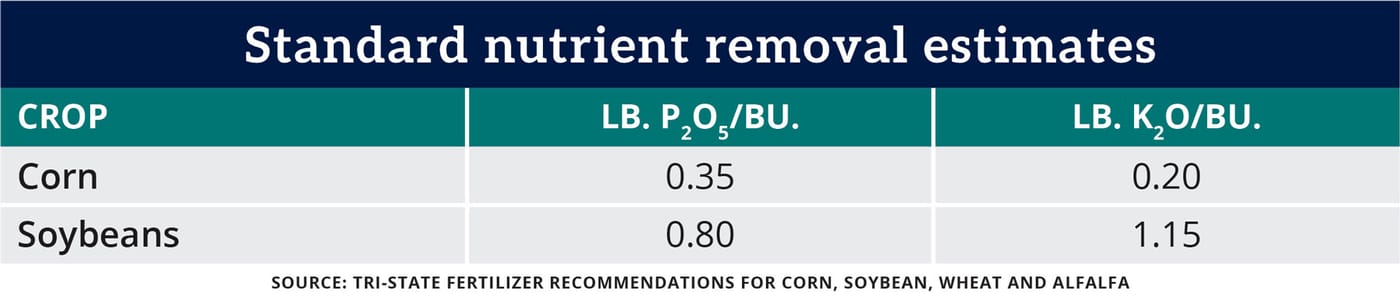
Another useful tool is measuring actual grain nutrient concentrations through laboratory analysis. Most soil testing laboratories offer grain nutrient analysis services. To collect a representative sample, gather grain from multiple locations across the field during harvest, combine the subsamples in a clean bucket, mix thoroughly, and submit a portion of the composite sample for testing.
Ultimately, grain removal data should not replace routine soil testing, but complement it. Together, these tools provide a clearer picture of nutrient cycling within a field and help ensure fertilizer investments are supporting both current crop production and long-term soil fertility goals.


