



Quick facts
There are 17 essential nutrients that all plants need, including carbon, hydrogen, and oxygen, which plants get from air and water.
Nitrogen, phosphorus, and potassium are needed in larger amounts than other nutrients; they are considered primary macronutrients.
Too much fertilizer is not only a waste of money, but it can damage plants and harm the environment.
With the right amount of nutrients, your garden can thrive and provide pounds of produce for harvest.
Plants need nutrients
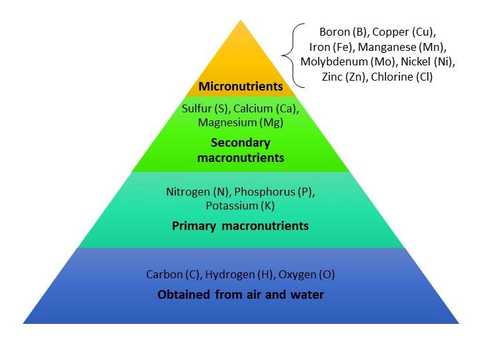
17 essential nutrients needed for normal plant growth
Like us, plants need nutrients in varying amounts for healthy growth. There are 17 essential nutrients that all plants need, including carbon, hydrogen, and oxygen, which plants get from air and water. The remaining 14 are obtained from soil but may need to be supplemented with fertilizers or organic materials such as compost.
Nitrogen, phosphorus, and potassium are needed in larger amounts than other nutrients; they are considered primary macronutrients.
Secondary macronutrients include sulfur, calcium, and magnesium.
Micronutrients such as iron and copper are necessary in much smaller amounts.
Nutrient availability in soils
Nutrient availability in soils is a function of several factors including soil texture (loam, loamy sand, silt loam), organic matter content and pH.
Texture
Clay particles and organic matter in soils are chemically reactive and will hold and slowly release nutrient ions that can be used by plants.
Soils that are finer-textured (more clay) and higher in organic matter (5-10%) have greater nutrient-holding ability than sandy soils with little or no clay or organic matter. Sandy soils in Minnesota are also more prone to nutrient losses through leaching, as water carries nutrients such as nitrogen, potassium or sulfur below the root zone where plants can no longer access them.
pH
Soil pH is the degree of alkalinity or acidity of soils. When pH is too low or too high, chemical reactions can alter the nutrient availability and biological activity in soils. Most fruits and vegetables grow best when soil pH is slightly acidic to neutral, or between 5.5 and 7.0.
There are some exceptions; blueberries, for example, require a low pH (4.2-5.2). Soil pH can be modified using materials like lime (ground limestone) to raise pH or elemental sulfur to lower pH.
Nutrient availability
In general, most Minnesota soils have enough calcium, magnesium, sulfur and micronutrients to support healthy plant growth. Nitrogen, phosphorus, and potassium are the nutrients most likely to be deficient and should be supplemented with fertilizers for optimum plant growth.


