



Soil tests reveal which fertilizers can make your lawn thrive. But how do you apply them? The different ways to apply fertilizer include broadcasting, banding, fertilizing using an aerator, foliar feeding, and fertigation.
By understanding all the ways to apply fertilizer, you can choose the one most suitable for your lawn. Note, though, that not all methods mentioned online are right for lawn care. So, we've put together the most common and effective application methods you can use for fertilizing your lawn and garden.
Common methods of applying fertilizer to lawns and gardens
There are different approaches to classifying a fertilizer. But for the purpose of determining the best ways to apply fertilizer, we're going to categorize them as either solid or liquid.
Solid fertilizers are also called granular fertilizers because they come in little granules that look like multi-colored pellets. Since these granules can take a while to break down, they're a good choice if you aim to provide nutrients at a slower rate.
Liquid fertilizers, on the other hand, are usually mixed with water. They provide a more concentrated form of nutrients delivered in a fast and efficient manner.
Solid fertilizers are like healthy meals, which take longer to produce results, while the liquid version is similar to an IV drip with immediate effects. After classifying the type of fertilizer you're using, you can now choose the application method. Note that the first three methods are usually chosen for applying granular fertilizers, while the last two are for liquid fertilizers.
1. Broadcasting
The main goal of broadcasting is to spread granular fertilizer over the growing area, then these granules are left to filter into the soil. Depending on the manufacturer's instructions, you also can incorporate the pellets into the soil with a spade or a tiller.
Pros of broadcasting:
Cost-effective
Wide coverage
Ease of application
Cons of broadcasting:
Nutrient loss
High risk of runoff and leaching
Can contribute to water pollution
2. Banding
This method is best for newly seeded lawns and plants, as it keeps the granular fertilizer a safe distance from the growing roots. It involves placing the granules in a narrow band applied in furrows, usually 3 inches from the seeds and 1 to 2 inches deeper.
Some homeowners also use this approach as a side dressing. After the plants' roots have been established, the nutrients in the soil may be already depleted. So, it's time to add another round of fertilizers to help rejuvenate or replenish soil nutrients.
Banding is also ideal for growing widely-spaced plants in your yard or garden bed. You can apply your solid fertilizer in a circle surrounding the plant, 3 to 4 inches from the base.
Pros of banding:
Efficient nutrient use
Reduces weed growth
Enhances early plant growth
Cons of banding:
Labor-intensive
Potential root burn
May require special equipment
3. Fertilizing using an aerator
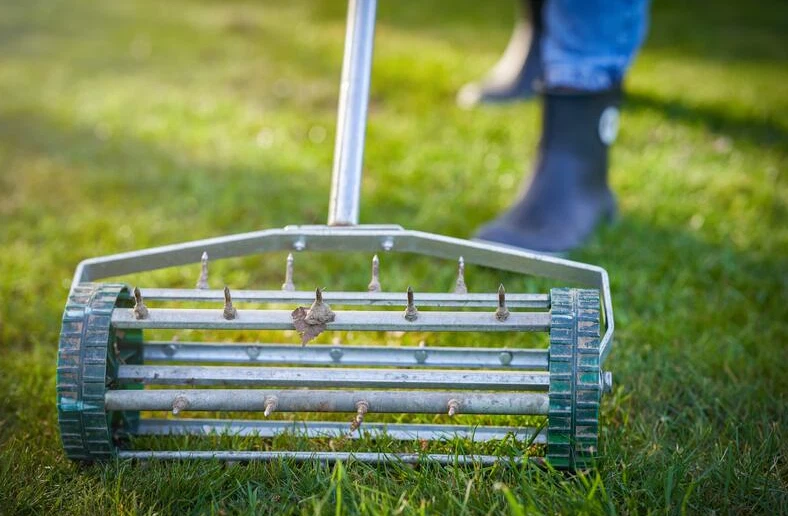
Regardless of the method used, the goal of applying solid fertilizer is to get the nutrients into the soil so your turf or plants can absorb them. But what if the soil is too compacted? That's where fertilizing with an aerator comes in, which helps the granules penetrate deeper into the root zone.
In lawn aeration, the process involves perforating the soil with small holes using specialized equipment like core aerators so that water and air can flow. To save money and time, you can add granular or powder fertilizer into these openings. Even if your soil is not compacted, you also can benefit from this method, as it helps prevent runoffs.
Pros of fertilizing using an aerator:
Reduced surface runoff
Efficient absorption of nutrients
Enhances soil health while reducing compaction
Cons of fertilizing using an aerator:
More expensive and labor-intensive
Only applicable for established lawns
Can disturb soil and root systems if done improperly
4. Foliar feeding
Liquid fertilizers are easier to work with, and foliar feeding is a great method you can use to apply them. The name itself can be loosely translated to "leaf" feeding, and the process is as easy as spraying the concentrated liquid directly onto the leaves. With foliar feeding, you can bypass the soil's limitation in quickly delivering nutrients to plants.
While some would argue that liquid fertilizers don't last as long as solid fertilizers embedded into the soil, the ease of spraying makes up for the reapplication process. For instance, if your turf is deficient in nitrogen and you want to solve the issue quickly, the straightforward approach of foliar feeding can help apply the nutrient directly.
In foliar feeding, you apply the liquid fertilizer directly to plant leaves, allowing the nutrients to be absorbed through the leaf surface. This application method provides a rapid nutrient uptake, so you can correct deficiencies more quickly than other soil-based fertilization methods.
Pros of foliar feeding:
Quick nutrient absorption
Useful for supplemental feeding
Bypasses soil issues like pH imbalance
Cons of foliar feeding:
Only small quantities can be applied at a time
Reduced effectiveness during extreme conditions
Frequent applications needed for sustained benefits
5. Fertigation
With decades of use in commercial agriculture, fertigation is fast becoming a method of choice even in residential landscapes because of its reliability and ease of use. But because of its expensive setup, fertigation is only suited for large lawns with an extensive irrigation or sprinkler system.
If you don't want to apply your liquid fertilizer through foliar feeding, you can go with fertigation instead. This method is a sort of automated process of foliar feeding. With fertigation, you'll use your irrigation system to distribute the water-soluble fertilizers along with the water in a drip or spray fashion.
Pros of fertigation:
Saves time and labor
Efficient use of water and nutrients
Precise application and nutrient delivery
Cons of fertigation:
Higher initial setup costs
Requires a well-maintained irrigation system
Can clog the irrigation system if not properly maintained
Pro tip: It can be very confusing which application method is best, and this does not even cover other important considerations, such as selecting and using inorganic fertilizers over organic ones. That's why it's always best to consult with lawn care experts if you want to avoid messing up your lawn.


