


Summary
CVR Partners is a compelling value play, benefiting from rising fertilizer prices and geopolitical risks impacting European natural gas supplies.
UAN offers a strong 10% dividend yield, stable operations, and low correlation with the broader market, making it an attractive portfolio hedge.
Geopolitical tensions in the Middle East, particularly around the Strait of Hormuz, could trigger a surge in European gas prices, improving fertilizer economics for US producers.
Even without a price spike, UAN remains undervalued with solid cash flow coverage, stable demand, and manageable debt, supporting long-term investment appeal.
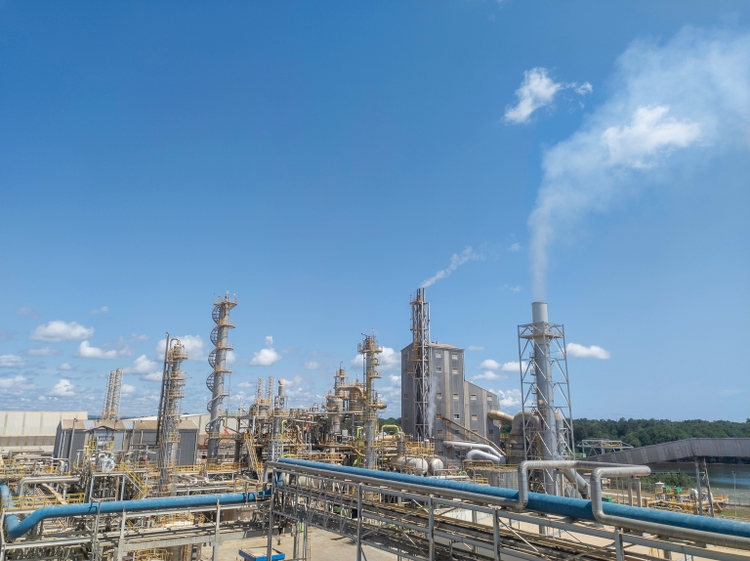
Muhammad Gunawansyah/iStock via Getty Images
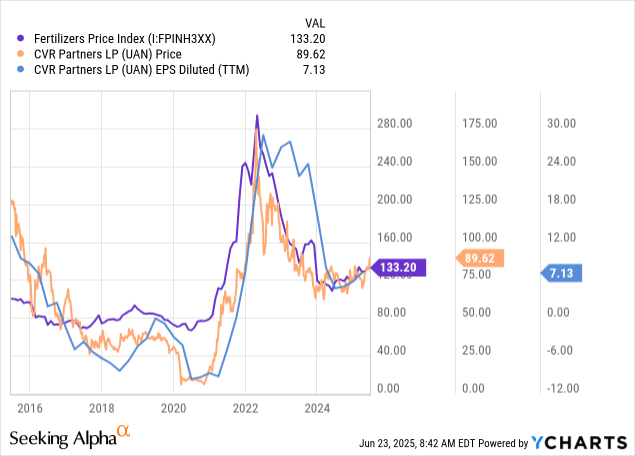
After being subdued for over two years, the fertilizers market is heating up again. The Fertilizers Price Index has risen about 13% over the past year. The index is still far below its 2022 highs, but a key inflection point has likely passed. The popular fertilizer stock CVR Partners (NYSE:UAN) is highly correlated to the Fertilizers Price index, rising about 18% year-to-date on expectations of an improvement in its EPS:
Data by YCharts
The possibility of a rebound in fertilizer prices improves CVR's profit outlook. The cost of fertilizers is highly subject to economic and trade conditions between the US and Europe. In general, fertilizer production consumes large amounts of natural gas. Higher gas prices increase production costs, which are typically higher in Europe than in the US, due to Europe's difficulty in replacing lost Russian pipelines. As such, when natural gas prices rise to a greater degree in Europe than in the US, European fertilizers production declines, and US exports to Europe rise, increasing prices and profits for US producers like CVR Partners.
That said, CVR Partners is also impacted by other economic factors such as trade with China, sanctions on the fertilizer export giants Russia and Belarus, and generally reduced global trade conditions around the Middle East. CVR Partners also benefits from a weaker US dollar, as that decreases import costs for European buyers, improving export demand.
I have historically had a bullish view on CVR Partners. I covered it last in 2022, expecting continued shortages due to higher foreign natural gas prices. My outlook did not prove correct, primarily due to decreases in European natural gas consumption resulting from abnormally warm winter weather, as well as the improvement in natural supply resulting from higher prices. Despite UAN falling 25% in value since then, its total return, which includes reinvested dividends, is 14%. In my view, this highlights the fact that UAN is a value opportunity regardless of fertilizer market conditions.
Europe's natural gas price remains far below 2022 levels. However, with Qatari exports making up for a portion of lost Russian exports, and Qatar being highly subject to the Hormuz risk factor, there is some concern that geopolitical risks may trigger another natural gas shortage in Europe. If so, we can expect UAN to rise in value as Europe's fertilizer production is expected to decline.
Geopolitics Triggers Fertilizer Prices Boom
The price of fertilizers rose in 2021, boomed in 2022 after the Russia-Ukraine war began, and has remained around 2021 levels since the price spike reversed. I see two root causes: one, the general increase in energy costs, and the ongoing supply shortfalls created in 2020. The second factor is geopolitical, which affects Europe's natural gas, ammonia, and potash supplies, creating a price imbalance that favors US fertilizer exporters.
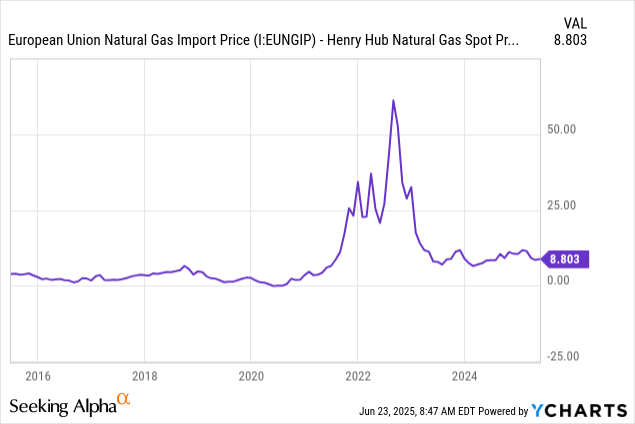
The price gap between EU natural gas and US natural gas is one of the more direct causes of rising fertilizer prices. Natural gas is the primary feedstock for ammonia, accounting for around 70-90% of production costs. In 2022, when natural gas rose above $100/MMBtu, 70% of European ammonia production was cut. The spike has since reversed, dragging fertilizers down with it. However, Europe's natural gas import prices settled at a chronically higher level compared to those in the US. See below:
Data by YCharts
Europe's natural gas shortage ended with improved Northern Hemisphere weather conditions in the 2022-2023 winter, quelling fears that European natural gas inventories would run low. Europe has since increased imports from the US, Norway, Qatar, and others to account for the likely permanent decline in Russian imports following the destruction of the Nord Stream pipelines.
Today, European natural gas storage levels are below average after being above average last year, around the same seasonal level as they were in 2022. Europe's gas storage likely improved in part because its prices were extremely high until 2023, prompting cuts in fertilizer production and increased natural gas imports.
I suspect there is a significant risk that Europe's natural gas sources may be threatened by the increasingly volatile situation in the Persian Gulf. For one, natural gas fields may be directly targeted, while Iran has threatened to halt trade (LNG and oil) through the Strait of Hormuz. Iran shares the largest natural gas field, South Pars, with Qatar, with its LNG being a vital source for natural gas across Eurasia.
Israel has already struck the gas field, though Qatari production has remained steady, while Iran's is partially suspended. Following US and Israeli strikes on Iran's nuclear sites, Iran's parliament passed a vote to block the Strait of Hormuz. Approximately one-fifth of the world's liquefied natural gas and crude oil flows through the Strait, making this a significant risk to Eurasian supplies.
The reality is that it is unclear if Iran's threats are realistic. I think it's objectively true that Iran has made far more threats than actions over recent weeks. This is not to dismiss the actions Iran has accomplished, only to state those actions are paltry compared to Iran's statements. As such, oil and gas prices have hardly reacted to Iran's threat to close the Strait, likely assuming this would undermine its relationship with India and China, while potentially being neither feasible nor sustainable.
Even then, I would not overlook this possibility. To me, it is potentially the only way Iran could significantly harm the US economy, without a direct attack that would only encourage further US military involvement. Goldman Sachs analysts predict that a Hormuz closure would push EU natural gas prices above $115 per MWh, or $33/MMBTU, which is around 250% higher.
I have had a bullish outlook on the US oil producer Diamondback (FANG) due to its potential as a hedge against this specific risk. I add CVR Partners to this hedge basket because it is not highly correlated to oil, but would also rise in value if Eurasia's natural gas supplies are compromised, given that it would increase Eurasian demand for US fertilizers.
UAN Undervalued Without Price Spike
UAN shares many similarities with FANG despite being in different industries and generally being uncorrelated. They're both US companies that should see higher product pricing due to greater US export demand resulting from an escalation in the Middle Eastern conflict. Further, like FANG, I argue UAN is undervalued today, even if we assume no change in product prices. A geopolitical risk event should benefit UAN; however, the stock should continue to provide value to long-term investors even if the global environment stabilizes.
UAN's dividend yield is a strong 10%, supported by a TTM "P/E" ratio of 12.5X. Although this dividend is not entirely covered by net income, it is covered by cash flow, as UAN's TTM price-to-operating cash flow is just 5.9X. UAN's dividend is variable, based on its income, given that it is a limited partnership
The company's operating focus remains stable and is primarily influenced by the macro conditions affecting the fertilizer industry. Its last investor call detailed high capacity utilization levels with a focus on Urea Ammonium Nitrate, and a smaller Ammonia segment. Its capital spending has risen in recent years, but it is essentially maintenance capital investment. The company looks to continue strong and stable demand for fertilizers from US farmers.
Although the US-EU natural gas pricing spread has a significant impact on global fertilizers trade, the US is a net importer of fertilizers. The last investor call noted that extended tariffs may increase US prices, benefiting local producers. Only Potash is tariff-exempt. However, it faces some indirect risk if US farm production eventually declines due to Chinese tariffs on the US.
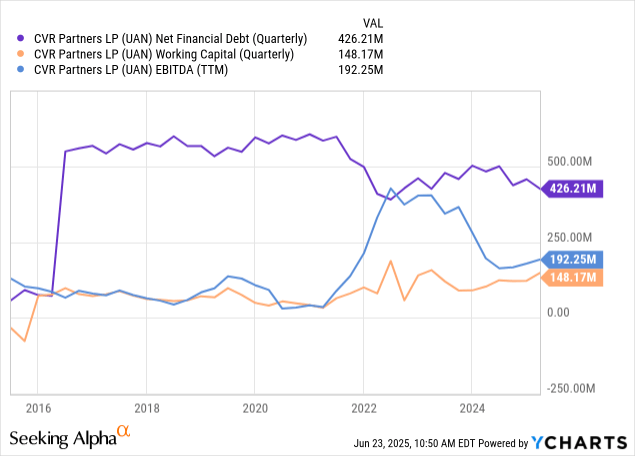
The company is levered with $426M in net debt, a reasonable level given its EBITDA has stabilized at potentially $200M. It also has a working capital surplus of $148M that has risen sharply over the past five years:
Data by YCharts
Fundamentally, CVR Partners is a relatively boring company. Its operations do not change frequently, reflecting the broader stability of the fertilizers industry. The fertilizers market and CVR Partners are not seeing excessive growth efforts, debt leverage concerns, or questionable managerial decisions.
Since 2020, the majority of price fluctuations in UAN's price and its dividend have been attributable to global supply-side issues. In my view, every year since 2020 has seen at least one event that has contributed to global supply shocks on various commodities. These have been related to wars, the pandemic, long-term skilled labor shortages, chronically low capital investment spending, weather events, and global trade policy and shipping issues.
The overarching trend has been an increased European reliance on US exports of energy items, accompanied by a decrease in the availability of goods like ammonia that require significant amounts of energy. Since natural gas has become the primary source of electrical energy in most western nations (decreasing reliance on coal), reductions in fertilizer production are an easy way to limit consumption in times of need without power grid shutdowns.
UAN's recent rally is likely driven in part by speculation regarding the Iran issue. Thus, I see the stock as a key portfolio hedge against this potentially significant risk factor. However, even if this risk declines, I see sustained value in CVR Partners. Its operational and financial risk profile is low, while it offers a very high double-digit dividend yield. Furthermore, due to its high exposure to fertilizer prices, its stock performance is not correlated with that of the S&P 500 (the R-squared value in daily performance is just 10%), and its recession risk is low. To me, that makes UAN a great portfolio addition regardless of geopolitical circumstances, but with potentially exceptional hedge potential should geopolitical escalation continue.
Of course, fertilizer prices may decline or costs may rise if the US faces energy issues not shared by its trading partners. Over time, a reduction in global supply-side issues could decrease fertilizer prices sufficiently to threaten UAN profits. The company can also face unplanned outages, capacity utilization issues, and labor cost challenges. Its risks are not necessarily low, but are generally uncorrelated with those of most stocks, meaning it should improve portfolio risk-return profiles.


