


Bill that would require Oregon farmers to report fertilizer usage dies in Senate committee
A bill in Salem seeking to require fertilizer reporting from large farms in the state in order to combat groundwater contamination died in committee early this year.
KGW's The Story has reported extensively on the issue in its "Tainted Waters" series, documenting how agriculture and food production have allowed harmful nitrates to seep into the soil, polluting underground aquifers accessed by hundreds, if not thousands, of residential wells in Morrow and Umatilla counties in eastern Oregon.
Background
More than 30 years ago, the state of Oregon discovered that a massive aquifer, covering 562 square miles near the town of Boardman, is contaminated with nitrates - a chemical you cannot see, taste or smell that is considered harmful for people above limits set by the Environmental Protection Agency, especially infants and pregnant women.
Many wells in the area have nitrate levels above those limits, mostly belonging to rural residents with lower income. In the affected area, called the Lower Umatilla Basin Groundwater Management Area, or "LUBGWMA," as many as 4,500 wells have drilled down through the earth to get water from the contaminated aquifer for cooking, bathing, drinking and more.
But over the decades, nitrates from farm fertilizer, commercial food production and large animal operations have seeped down into the water, making the contamination worse.
A state report released back in February included the below graphic; every orange and red circle here represents a well where the water should not be used for drinking or cooking.
There are a lot of contaminated wells around Boardman to Hermiston, and those are just wells that have been tested for nitrate contamination at the time of the report.
Where does the contamination come from?
The Oregon Department of Environmental Quality, or DEQ, has used these estimates for the past few years.
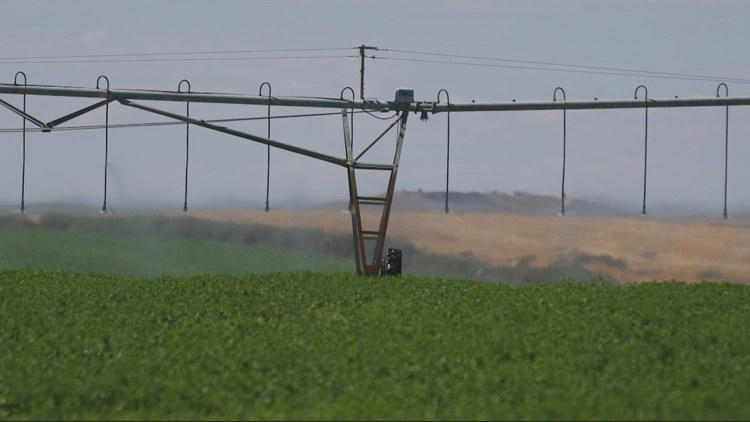
Irrigated agriculture makes up the lion's share of contribution - nearly 70% - mostly due to fertilizer the farms use to grow their crops. If the plants are not able to soak up all the fertilizer, it seeps into the aquifer, contaminating the water.
For decades, the state has relied on voluntary actions by farmers to try to stop the contamination, but those have not worked - in fact, the contamination has just gotten worse.
Meanwhile, efforts to regulate fertilizer use or require action on the part of farmers and businesses in the area have gone nowhere.
The bill at hand
That includes a bill introduced this legislative session in Salem, Senate Bill 747, which would require farmers with at least 200 acres to report how much fertilizer they use on their fields to the state Department of Agriculture. Then, the DEQ could look at the data and potentially fine farmers who use too much fertilizer, affecting the groundwater below.
Rep. Bobby Levy, R-Echo, testified to a Senate committee earlier this year, urging them to kill the bill, asking for voluntary efforts - which, as we've reported, simply don't work, and haven't, for decades.
The Republican state lawmaker, who represents most of Umatilla and all of Union and Wallowa counties, also testified that suggesting overapplication of fertilizer is "widespread" is inaccurate and unfair.
However, the bill failed to advance, and did ultimately die in the Senate committee.


